New PT0-003 Exam Questions - PT0-003 Real Exams
Wiki Article
BTW, DOWNLOAD part of Getcertkey PT0-003 dumps from Cloud Storage: https://drive.google.com/open?id=1DhosTtRLb-siHcwy-PcAusifNFcDq66a
Getcertkey assists people in better understanding, studying, and passing more difficult certification exams. We take pride in successfully servicing industry experts by always delivering safe and dependable exam preparation materials. All of our CompTIA PT0-003 exam questions follow the latest exam pattern. We have included only relevant and to-the-point CompTIA PT0-003 Exam Questions for the CompTIA PenTest+ Exam exam preparation. You do not need to waste time preparing for the exam with extra or irrelevant outdated CompTIA PT0-003 exam questions.
CompTIA PT0-003 Exam copyright Topics:
| Topic | Details |
|---|---|
| Topic 1 |
|
| Topic 2 |
|
| Topic 3 |
|
| Topic 4 |
|
| Topic 5 |
|
>> New PT0-003 Exam Questions <<
Free PDF Quiz 2026 PT0-003: CompTIA PenTest+ Exam High Hit-Rate New Exam Questions
With vast experience in this field, Getcertkey always comes forward to provide its valued customers with authentic, actual, and genuine PT0-003 exam dumps at an affordable cost. All the CompTIA PenTest+ Exam (PT0-003) questions given in the product are based on actual examination topics. Getcertkey provides three months of free updates if you purchase the CompTIA PT0-003 Questions and the content of the examination changes after that.
CompTIA PenTest+ Exam Sample Questions (Q251-Q256):
NEW QUESTION # 251
SIMULATION
A penetration tester performs several Nmap scans against the web application for a client.
INSTRUCTIONS
Click on the WAF and servers to review the results of the Nmap scans. Then click on each tab to select the appropriate vulnerability and remediation options.
If at any time you would like to bring back the initial state of the simulation, please click the Reset All button.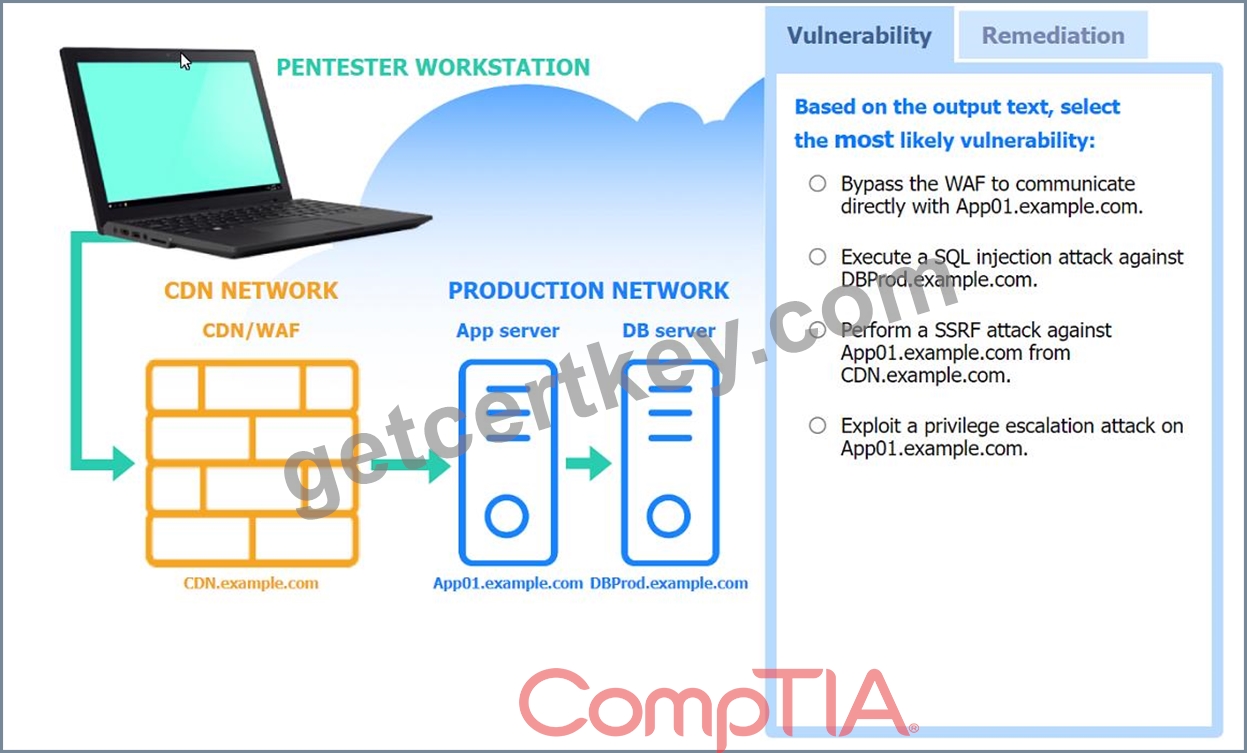
Answer:
Explanation:
See the explanation part for detailed solution
Explanation: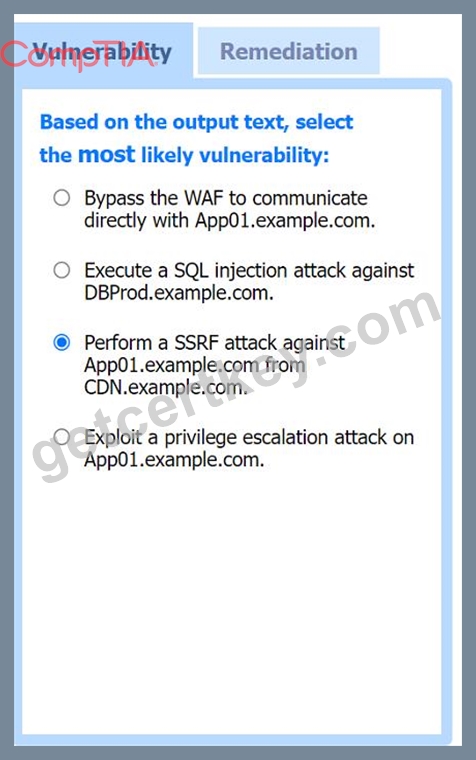
Most likely vulnerability: Perform a SSRF attack against App01.example.com from CDN.example.com.
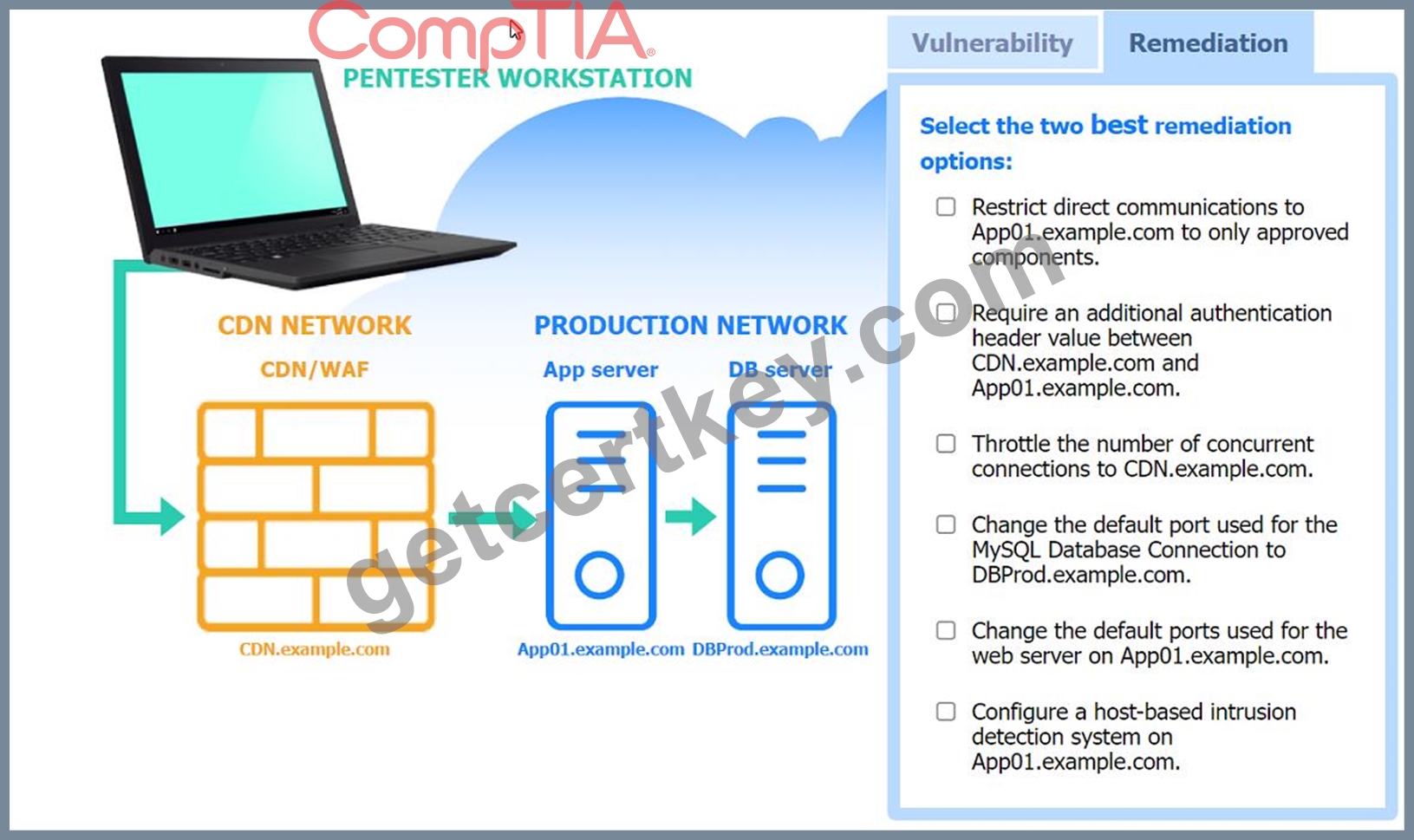
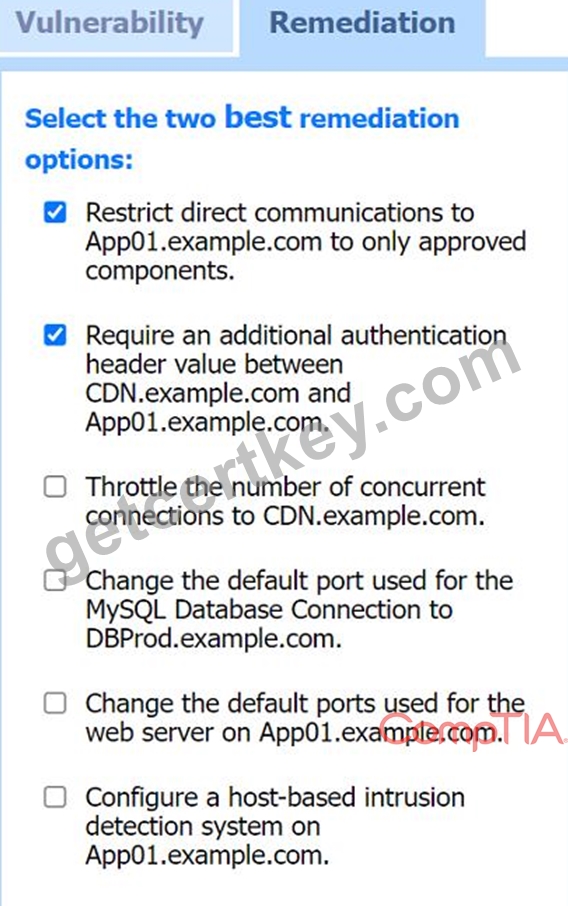
Two best remediation options:
Restrict direct communications to App01.example.com to only approved components.
Require an additional authentication header value between CDN.example.com and App01.example.com.
Restrict direct communications to App01.example.com to only approved components: This limits the exposure of the application server by ensuring that only specified, trusted entities can communicate with it.
Require an additional authentication header value between CDN.example.com and App01.example.com: Adding an authentication layer between the CDN and the app server helps ensure that requests are legitimate and originate from trusted sources, mitigating SSRF and other indirect attack vectors.
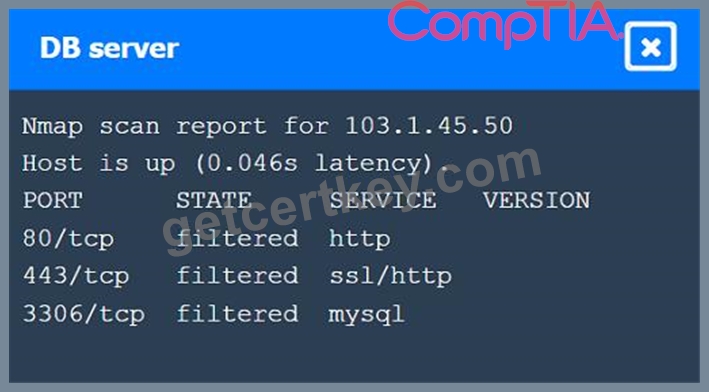
Nmap Scan Observations:
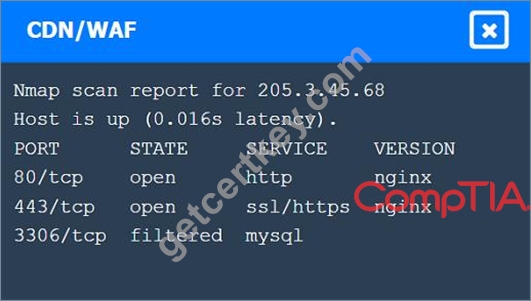
CDN/WAF shows open ports for HTTP and HTTPS but filtered for MySQL, indicating it acts as a filtering layer.
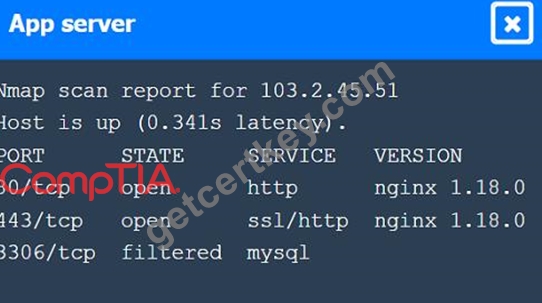
App Server has open ports for HTTP, HTTPS, and filtered for MySQL.
DB Server has all ports filtered, typical for a database server that should not be directly accessible.
These findings align with the SSRF vulnerability and the appropriate remediation steps to enhance the security of internal communications.
NEW QUESTION # 252
A compliance-based penetration test is primarily concerned with:
- A. determining the efficacy of a specific set of security standards.
- B. obtaining specific information from the protected network.
- C. obtaining Pll from the protected network.
- D. bypassing protection on edge devices.
Answer: A
NEW QUESTION # 253
In a file stored in an unprotected source code repository, a penetration tester discovers the following line of code:
sshpass -p donotchange ssh [email protected]
Which of the following should the tester attempt to do next to take advantage of this information? (Select two).
- A. Run a password-spraying attack with Hydra against all the SSH servers.
- B. Use an external exploit through Metasploit to compromise host 192.168.6.14.
- C. Investigate to find whether other files containing embedded passwords are in the code repository.
- D. Confirm whether the server 192.168.6.14 is up by sending ICMP probes.
- E. Use Nmap to identify all the SSH systems active on the network.
- F. Take a screen capture of the source code repository for documentation purposes.
Answer: C,F
Explanation:
When a penetration tester discovers hard-coded credentials in a file within an unprotected source code repository, the next steps should focus on documentation and further investigation to identify additional security issues.
Explanation:
* Taking a Screen Capture (Option B):
* Documentation: It is essential to document the finding for the final report. A screen capture provides concrete evidence of the discovered hard-coded credentials.
* Audit Trail: This ensures that there is a record of the vulnerability and can be used to communicate the issue to stakeholders, such as the development team or the client.
* Investigating for Other Embedded Passwords (Option C):
* Thorough Search: Finding one hard-coded password suggests there might be others. A thorough investigation can reveal additional credentials, which could further compromise the security of the system.
* Automation Tools: Tools like truffleHog, git-secrets, and grep can be used to scan the repository for other instances of hard-coded secrets.
Pentest References:
* Initial Discovery: Discovering hard-coded credentials often occurs during source code review or automated scanning of repositories.
* Documentation: Keeping detailed records of all findings is a critical part of the penetration testing process. This ensures that all discovered vulnerabilities are reported accurately and comprehensively.
* Further Investigation: After finding a hard-coded credential, it is best practice to look for other security issues within the same repository. This might include other credentials, API keys, or sensitive information.
Steps to Perform:
* Take a Screen Capture:
* Use a screenshot tool to capture the evidence of the hard-coded credentials. Ensure the capture includes the context, such as the file path and relevant code lines.
* Investigate Further:
* Use tools and manual inspection to search for other embedded passwords.
* Commands such as grep can be helpful:
grep -r 'password' /path/to/repository
* Tools like truffleHog can search for high entropy strings indicative of secrets:
trufflehog --regex --entropy=True /path/to/repository
By documenting the finding and investigating further, the penetration tester ensures a comprehensive assessment of the repository, identifying and mitigating potential security risks effectively.
NEW QUESTION # 254
Which of the following protocols would a penetration tester most likely utilize to exfiltrate data covertly and evade detection?
- A. DNS
- B. HTTPS
- C. FTP
- D. SMTP
Answer: A
Explanation:
Covert data exfiltration is a crucial aspect of advanced penetration testing. Penetration testers often need to move data out of a network without being detected by the organization's security monitoring tools. Here's a breakdown of the potential methods and why DNS is the preferred choice for covert data exfiltration:
FTP (File Transfer Protocol) (Option A):
Characteristics: FTP is a clear-text protocol used to transfer files.
Drawbacks: It is easily detected by network security tools due to its lack of encryption and distinctive traffic patterns. Most modern networks block or heavily monitor FTP traffic to prevent unauthorized file transfers.
Reference:
HTTPS (Hypertext Transfer Protocol Secure) (Option B):
Characteristics: HTTPS encrypts data in transit, making it harder to inspect by network monitoring tools.
Drawbacks: While HTTPS is more secure, large amounts of unusual or unexpected HTTPS traffic can still trigger alerts on sophisticated security systems. Its usage for exfiltration depends on the network's normal traffic patterns and the ability to blend in.
SMTP (Simple Mail Transfer Protocol) (Option C):
Characteristics: SMTP is used for sending emails.
Drawbacks: Like FTP, SMTP is not inherently secure and can be monitored. Additionally, large or frequent email attachments can trigger alerts.
DNS (Domain Name System) (Option D):
Characteristics: DNS is used to resolve domain names to IP addresses and vice versa.
Advantages: DNS traffic is ubiquitous and often less scrutinized than other types of traffic. Data can be encoded into DNS queries and responses, making it an effective covert channel for exfiltration.
Conclusion: DNS tunneling stands out as the most effective method for covert data exfiltration due to its ability to blend in with normal network traffic and avoid detection by conventional security mechanisms. Penetration testers utilize this method to evade scrutiny while exfiltrating data.
NEW QUESTION # 255
When preparing for an engagement with an enterprise organization, which of the following is one of the MOST important items to develop fully prior to beginning the penetration testing activities?
- A. Interview all stakeholders.
- B. Identify all third parties involved.
- C. Obtain an asset inventory from the client.
- D. Clarify the statement of work.
Answer: D
Explanation:
Clarifying the statement of work is one of the most important items to develop fully prior to beginning the penetration testing activities, as it defines the scope, objectives, deliverables, and expectations of the engagement. The statement of work is a formal document that outlines the agreement between the penetration tester and the client and serves as a reference for both parties throughout the engagement. It should include details such as the type, duration, and frequency of testing, the target systems and networks, the authorized methods and tools, the reporting format and schedule, and any legal or ethical considerations.
NEW QUESTION # 256
......
Are you looking for a reliable product for the PT0-003 exam? If you do, our product will be your best choice. The reference materials of our company are edited by skilled experts and profestionals who are quite famialiar with the latest exam and testing center for yaers, therefore the quality of the practice materials for the PT0-003 exam is guaranteed. Besides the practice material provide the demo, and you can have a try before you buy it,and the questions and answers online of the practice materials for thePT0-003 Exam can also be seen. If you just wan to test yourself, you can can conceal it, after you finish it , yon can seen the answers by canceling the conceal. It's quite convenient and effective.
PT0-003 Real Exams: https://www.getcertkey.com/PT0-003_braindumps.html
- Valid PT0-003 Real Test ☢ Valid Exam PT0-003 Vce Free ???? Latest PT0-003 Dumps Ebook ???? Easily obtain free download of “ PT0-003 ” by searching on 【 www.examcollectionpass.com 】 ????Vce PT0-003 Free
- Online PT0-003 Lab Simulation ???? PT0-003 Actualtest ???? New PT0-003 Exam Discount ???? Search for ▛ PT0-003 ▟ and easily obtain a free download on ✔ www.pdfvce.com ️✔️ ????Exam Sample PT0-003 Questions
- New PT0-003 Dumps Pdf ???? Vce PT0-003 Free ???? Valid PT0-003 Exam copyright ???? Immediately open ⮆ www.prep4sures.top ⮄ and search for ➤ PT0-003 ⮘ to obtain a free download ????New PT0-003 Test Preparation
- PT0-003 Exam Paper Pdf ???? Valid PT0-003 Real Test ???? New PT0-003 Dumps Pdf ???? Go to website ➥ www.pdfvce.com ???? open and search for 【 PT0-003 】 to download for free ????Study PT0-003 Group
- CompTIA New PT0-003 Exam Questions: CompTIA PenTest+ Exam - www.examcollectionpass.com Instant Download ???? Simply search for ( PT0-003 ) for free download on ➠ www.examcollectionpass.com ???? ????Study PT0-003 Group
- Valid New PT0-003 Exam Questions - Leader in Certification Exams Materials - Free Download PT0-003 Real Exams ???? Simply search for ➡ PT0-003 ️⬅️ for free download on ✔ www.pdfvce.com ️✔️ ????Study PT0-003 Group
- Pass Guaranteed 2026 CompTIA PT0-003 –Valid New Exam Questions ???? Search for ▛ PT0-003 ▟ and download it for free immediately on 「 www.practicevce.com 」 ????Valid PT0-003 Exam copyright
- PT0-003 Exam Quick Prep ⚡ PT0-003 Top Dumps ⛄ Vce PT0-003 Free ???? Search for ➡ PT0-003 ️⬅️ and obtain a free download on ▷ www.pdfvce.com ◁ ????New PT0-003 Exam Discount
- Pass Guaranteed Quiz CompTIA - Professional PT0-003 - New CompTIA PenTest+ Exam Exam Questions ???? [ www.practicevce.com ] is best website to obtain [ PT0-003 ] for free download ????PT0-003 Interactive Practice Exam
- Valid New PT0-003 Exam Questions - Leader in Certification Exams Materials - Free Download PT0-003 Real Exams ↘ Search for 《 PT0-003 》 and obtain a free download on 「 www.pdfvce.com 」 ????Dumps PT0-003 Free
- Get CompTIA PT0-003 Dumps Questions [] To Gain Brilliant Result ???? Search for { PT0-003 } on ✔ www.examdiscuss.com ️✔️ immediately to obtain a free download ????PT0-003 Interactive Practice Exam
- haimacvzo277298.wizzardsblog.com, elainexhzu404441.blogsidea.com, janefkat456504.topbloghub.com, junaideyxi831819.evawiki.com, aishabbqi671125.governor-wiki.com, bookmarkrange.com, gerardcvva910604.mdkblog.com, joshibvz702241.blgwiki.com, deweyrzsm050711.topbloghub.com, bookmarkingdepot.com, Disposable vapes
2026 Latest Getcertkey PT0-003 copyright and PT0-003 copyright Free Share: https://drive.google.com/open?id=1DhosTtRLb-siHcwy-PcAusifNFcDq66a
Report this wiki page